Method / Measurement

Every session is measured, not remembered.

A session is scored from sensor data, not from feel. We log entry speed, braking point, line deviation and lap delta on every run, then compare your first block against your last. An instructor walks the traces with you before you leave the track.

Entry speed
Sampled at the last marker before turn-in, in km/h.
Braking point
Metres past the reference board where full pedal pressure begins.
Line deviation
Distance off the reference line at apex, logged lap by lap.
Delta
Gap to your best lap of the day, shown in tenths of a second.

Skills training for already-licensed drivers, held in closed, controlled environments under professional supervision. Not a licensing course, and no practice on public roads. Read the full telemetry glossary

Method / Drill sequence

Three drills, run in this order

Each drill repeats until the spread between your best and weakest pass stops moving. All practice happens in closed, controlled environments under instructor supervision, never on public roads.

  1. 01

    Threshold braking

    Build pedal pressure until the ABS is about to engage, then hold that exact point instead of stabbing past it. Once your braking point stops drifting between passes, we move on.

    Environment
    Airfield braking lane, dry and wet
    Duration
    45 min
    Tracked
    Entry speed, braking point
  2. 02

    Cornering line work

    Set a reference line through a constant-radius bend, then change entry speed one step at a time and read how exit speed and line deviation answer back. The aim is a repeatable line, not a fast lap.

    Environment
    Closed handling circuit, dry
    Duration
    60 min
    Tracked
    Line deviation, delta per pass
  3. 03

    Low-speed skid recovery

    Oversteer is induced deliberately at 40 to 60 km/h on a wet skid pad. The task is a measured correction you can repeat, rather than a fast reflex you cannot explain afterwards.
    Environment
    Wet skid pad, 40 to 60 km/h
    Duration
    40 min
    Tracked
    Entry speed, correction count
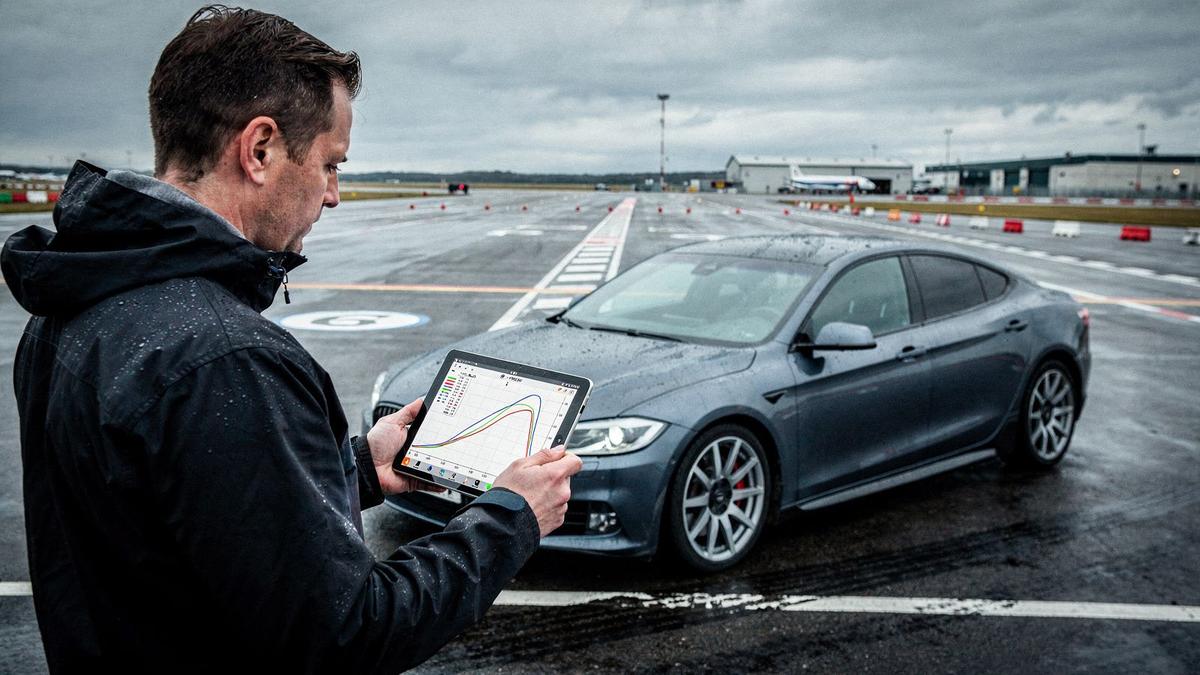
Instructor beside a sedan in a wet airfield braking lane, holding a tablet with a telemetry trace on screen
Pass 7 · 0:14.2 · wet braking lane, threshold held

Entry speed, braking point, line deviation and delta are defined in the telemetry glossary.

Telemetry vocabulary

Five readings behind every debrief

Every run on the closed handling course is logged at 10 Hz. These are the terms your instructor will use after the last run, and what each one actually measures.

Term Unit What it measures
Entry speed km/h Vehicle speed at the final timing loop before turn-in, reported as a peak rather than an average, so a single late lift shows up at once.
Braking point m Distance from the apex where brake pressure first exceeds 10 bar. A late braking point shifts the whole corner, and the trace shows it across the next three loops.
Line deviation cm Average lateral distance between your driven path and the reference line. Anything above 40 cm almost always traces back to a turn-in that arrives late.
Delta s Signed time difference to your reference lap at the same point on the course. Negative means time gained, positive means time lost.
Reference lap lap Your fastest clean lap of the session, set with no traffic and no instructor input. Every other number here is measured against it.

Comparisons stay internal: no lap of yours is measured against another driver. See how the data is produced in the drill sequence, or ask about a session slot.

Step 05 / Decide

Compare both programmes before you book a seat

The skid module and the braking module differ in seat time, surface condition and prerequisite level. The programme comparison table on the home page lists entry requirements, session length and the exact telemetry set you take home: entry speed, braking point and line deviation.

Every practice run happens on a closed, controlled surface under professional supervision. This is skills training for already-licensed drivers, built to reduce risk, and it does not replace any official requirement.

Request a seat

Prefer to talk it through? Call +380 738 982 8842